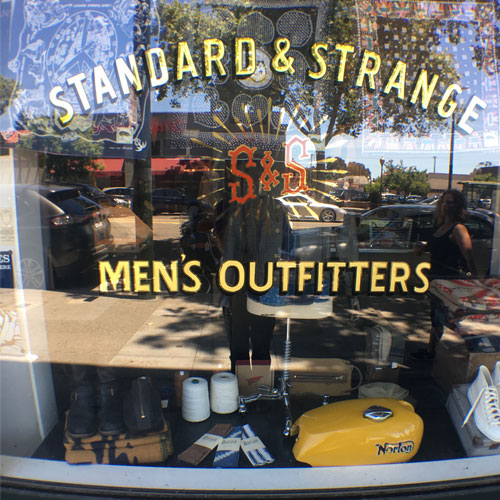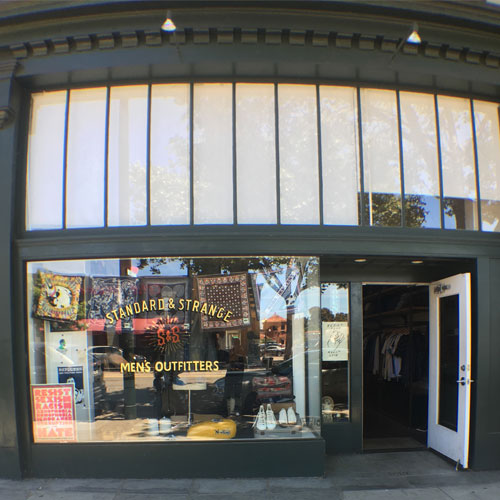
Some years ago I stopped by specialty menswear shop Standard & Strange in Oakland’s creative Temescal neighborhood, to talk with Neil Berrett, who, along with Jeremy Smith, co-founded the business in 2012 (note: S&S moved to nearby Berkeley in 2025). If you’ve read our post on Tokyo you’ll know that I came away impressed by The Real McCoy’s, an Americana-themed apparel brand with a shop in Tokyo’s Shibuya neighborhood. When I asked where one might be able to find their exclusive merchandise back in the States I was given a somewhat unexpected answer. It wasn’t New York, it wasn’t LA, not Chicago or Portland. The only stockist in America for the McCoy’s brand at the time was located in Oakland at guess where? A short twelve-minute drive from my home.
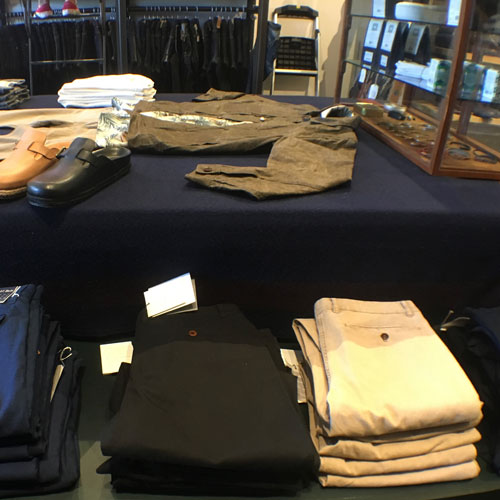
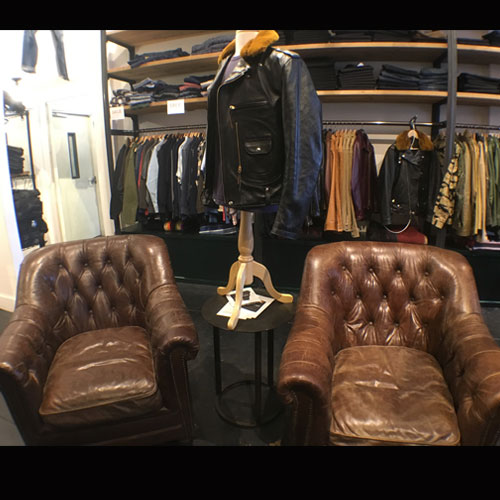
After a warm welcome from Brandon, the store’s manager, Neil and I sank down in twin milk chocolate, vintage leather club chairs, positioned right in the middle of his eclectic shop. Racks of jeans, folded shirts, jackets, tees and more encircled us.
“We wanted to bring the type of men’s clothing that my business partner and I wore, to the East Bay,” Neil began. “We didn’t have a place where we liked shopping for clothes and we wanted to carry products we gave a shit about, stuff that was ethically made, things that got better over time.”
Neil and Jeremy began the way many do, by first learning what not to do. They got into the business following a passion of making the “just right” cycling jersey. This led directly to a deeper understanding and appreciation of fabric manufacture, the type of mills that produce the kind of fabric they required, and product scale.
“We had a bunch of jerseys we had cut and sewn down at a factory in San Leandro. We got the best trims and components for fantastic jerseys and we still have people Email us and say, ‘This is the best jersey ever’. We did some retail space in the neighborhood in an alley as our first store…but we didn’t have enough product.”
Fully invested in their mission to make clothes of high quality available, Neil and Jeremy borrowed some inventory; soon one stack of jeans led to two, which turned into more, and they started to develop their niche from there.
“At first we were only doing US made goods, which was too limiting, so we branched out to Europe and Japan, and we found really good knitwear and outerwear from the UK and Europe. But I still think the Japanese make the best jeans.”
As we landed on the subject of denim the excitement in Neil’s voice began to rise.
“Their textile industry is more varied than in the states…in Japan you have a lot of these really tiny mills willing to do more experimental stuff. In the States a lot of these mills won’t talk to you unless you want 10,000 yards for something custom.” He explained that they work with US based mills like Cone (making denim since the late 19th century) and Safe Denim who will work with labels to make custom yarns at a smaller scale.
Quality Drives the Brand
This led us to the esoteric subject of quality in general. Quality goods (and services) have been made for centuries but sometime around the Internet’s 12th birthday, the chroniclizaton (not a word but indulge me) of that level of detail and history, the sheer quantity of information around everything and it’s mama began to feed subcultures that were ready for small batch bourbon, artisanal pickles and, of course, denim. After a wave of Portlandia-ish level obsession passed, there still exists a genuine desire among merchants and consumers to simply understand the provenance of their product’s manufacture (thanks in part to that wave of obsession). There’s a sustainability element to this, but also a need to be as knowledgeable about the how, when and where for your clothes as anything else. The good news for boutique level shops, and folks like Neil and Jeremy, was that along with that informed consumer comes a willingness to invest more in pieces that mean more, and last a little longer.
“The standard of quality for fast fashion has gone down. Over the last ten years as textile prices and maybe manufacturing prices have gone up, the price of the clothing hasn’t gone up in proportion, and I think it’s actually gotten worse. On the other hand, the consumer’s standard of quality has risen…you go to most cities and you can find a killer pop-up. 10 years ago you had to seek it out. Everyone’s standard of quality on a larger scale, for more premium things has gone up, so I think people are ready for it.”
And people in Oakland are ready for the kinds of clothes Standard & Strange keeps on hand. In addition to The Real McCoy’s, they carry denim brands like 3sixteen, OrSlow, Indigofera, Momotaro, Freenote and more, and all of which source very particular grades of denim and fabric for their apparel. For example, Momotaro sources cotton from Zimbabwe that is hand picked, so it contains less impurities and lends itself to a softer more uniform nature. Neil mentioned Standard & Strange was working on a proprietary line as well.
What S&S Looks For
“We’ve been doing a lot of collaborations, we did one with Alden, Ooe Yofukuten, Freenote, 3sixteen, Rogue Territory…and Wesco, we do a lot of custom made stuff with them.”
All of the brands have to meet a minimum level of quality, which helps distinguish Standard & Strange from other stores and is in keeping with the ethos Neil and Jeremy were first after.
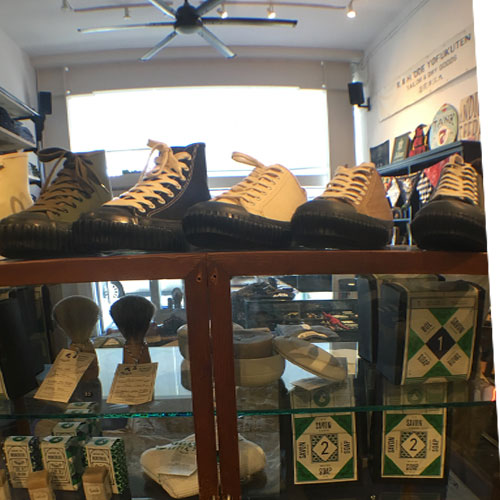
“A new brand needs to fill a hole that I don’t have…so there’s gotta be a combination of an interesting brand story or a long history of doing something better than everyone else. Case in point, we just brought on John Lofgren, they make sneakers and boots from Japan. He does everything to the best of his ability. His sneakers are fantastic, we stocked some that featured old kakishibu dyed denim, a persimmon dye. He also had some made with sugarcane denim fabric, and so the brand had the right mix of being unique while still made exceptionally well…and they were great fucking sneakers. Same thing for his boots. He makes them in a small factory, they’re Goodyear welted, every detail is just so. He’s very particular about overusing components from 1st world countries too. He spent over a year trying to find the right buckle to use; so for us to bring in a new brand, generally it has these kind of characteristics.”
Standard & Strange will be headed to New York this week to check out 2018’s S/S collections from a couple of shows that cater to Americana-styled clothing. Shows such as Capsule, Man and Clutch Collection in Japan will attract similar buyers around the world and it will be a chance to talk shop, renew acquaintances and discover new brands.
It was only a matter of time before our conversation turned to food. Next door to Standard & Strange is a gourmet pizzeria (Pizzaiolo, helmed by Charlie Hallowell) that’s been in business for years. Often enough, someone waiting for their pizza will wander into the shop and be somewhat surprised at the price of a pair of jeans. To this, Neil offers some sage wisdom.
“We’re selling the same thing…they have food that’s made really well, they use the best ingredients, the focus is on quality and experience…we’re doing the same thing only with clothes…you’re going to spend at least $100 on dinner, and poop it out the next day. At least the jeans will last for years.”
Standard & Strange, 755 Hearst Avenue Berkeley, CA. (510) 373-9696 Standardandstrange.com